Research, Development and Demonstration (RD&D) activities play a critical role in accelerating the transition to a low-carbon, circular economy. Through a portfolio of national and European projects, the Irish Bioenergy Association (IrBEA) is working with industry, researchers, landowners and communities to develop innovative solutions that unlock greater value from biomass resources.
IrBEA’s RD&D programme focuses on transforming agricultural, horticultural and forestry residues into high-value products, renewable energy and carbon removal solutions. Through projects such as Interreg NWE’s CASCADE, C5, VALORANT, EU Just Transition Fund BIOCHAR and PPS BIOCHAR, IrBEA is investigating how biomass can be used more efficiently across multiple sectors including agriculture, horticulture, forestry systems, construction and biomaterials, biogas, biofuels, urban greening, water management and carbon negative energy systems.
Research activities provide the scientific foundation for understanding feedstock quality, carbon impacts and sustainable value chains. Development work then translates this knowledge into practical technologies and processes, including biochar production systems, circular construction materials, nutrient recovery pathways and decision-support tools.
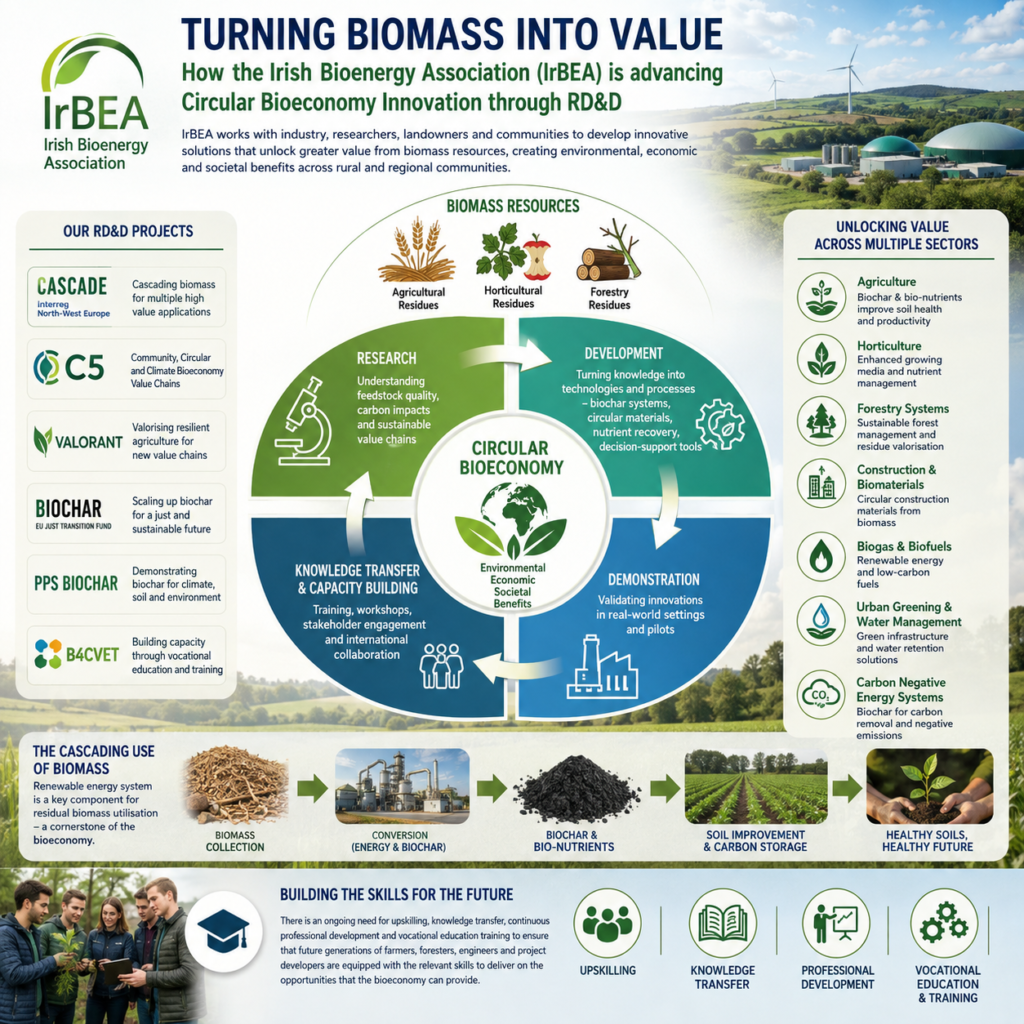
A key aspect of IrBEA’s approach is demonstration. Working with partners across Ireland and Europe, the association is validating these innovations in real world settings. Current demonstration activities include biochar and bio-nutrient trials in commercial horticulture, biomass-to-biochar conversion systems, and the development of new circular construction materials derived from agricultural feedstocks. These pilots demonstrate the cascading use of biomass with the renewable energy system as a key component for residual biomass utilisation, a cornerstone of the bioeconomy. They also help assess technical performance, environmental benefits and commercial viability while supporting stakeholder confidence and market uptake.
Knowledge transfer and capacity building are central to all project activities. Through training programmes, workshops, stakeholder engagement and international collaboration and projects like the B4CVET, IrBEA is helping to build the skills and networks needed to support the growth of a sustainable bioeconomy. By connecting research with practical deployment, it’s RD&D activities are creating pathways for innovation that deliver environmental, economic and societal benefits across rural and regional communities.
Through IrBEA’s RD&D activities, it has become evident over the last decade that there is an ongoing need for upskilling, knowledge transfer, continuous professional development and vocational education training to ensure that future generations of farmers, foresters, engineers and project developers are equipped with the relevant skills to continue to deliver on the opportunities that the bioeconomy can provide when exploring biomass to biochar value chains.
Disclaimer
Co-funded by the European Union. Views and opinions expressed are however those of the author(s) only and do not necessarily reflect those of the European Union or the European Education and Culture Executive Agency (EACEA). Neither the European Union nor EACEA can be held responsible for them.